|
Upcoming Seminars and Events
|
| May 15, 2026 |
-
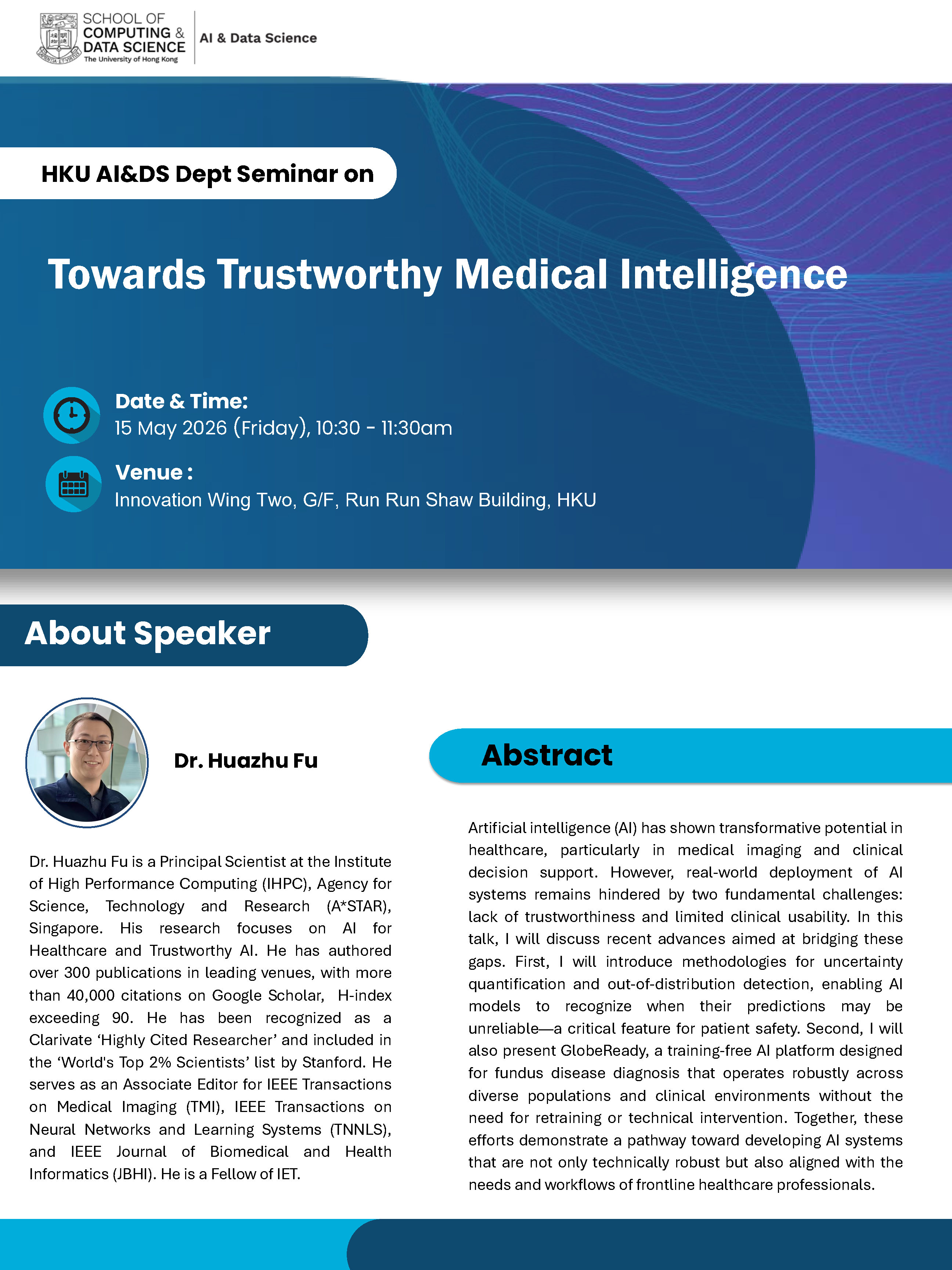
Title: Towards Trustworthy Medical Intelligence
Time: 10:30am
Venue: Innovation Wing Two, G/F, Run Run Shaw Building
Speaker(s): Dr. Huazhu Fu
Remark(s): Abstract
Artificial intelligence (AI) has shown transformative potential in healthcare, particularly in medical imaging and clinical decision support. However, real-world deployment of AI systems remains hindered by two fundamental challenges: lack of trustworthiness and limited clinical usability. In this talk, I will discuss recent advances aimed at bridging these gaps. First, I will introduce methodologies for uncertainty quantification and out-of-distribution detection, enabling AI models to recognize when their predictions may be unreliable—a critical feature for patient safety. Second, I will also present GlobeReady, a training-free AI platform designed for fundus disease diagnosis that operates robustly across diverse populations and clinical environments without the need for retraining or technical intervention. Together, these efforts demonstrate a pathway toward developing AI systems that are not only technically robust but also aligned with the needs and workflows of frontline healthcare professionals.
About the speaker
Dr. Huazhu Fu is a Principal Scientist at the Institute of High Performance Computing (IHPC), Agency for Science, Technology and Research (A*STAR), Singapore. His research focuses on AI for Healthcare and Trustworthy AI. He has authored over 300 publications in leading venues, with more than 40,000 citations on Google Scholar, H-index exceeding 90. He has been recognized as a Clarivate ‘Highly Cited Researcher’ and included in the ‘World's Top 2% Scientists’ list by Stanford. He serves as an Associate Editor for IEEE Transactions on Medical Imaging (TMI), IEEE Transactions on Neural Networks and Learning Systems (TNNLS), and IEEE Journal of Biomedical and Health Informatics (JBHI). He is a Fellow of IET.
|
| May 18, 2026 |
-
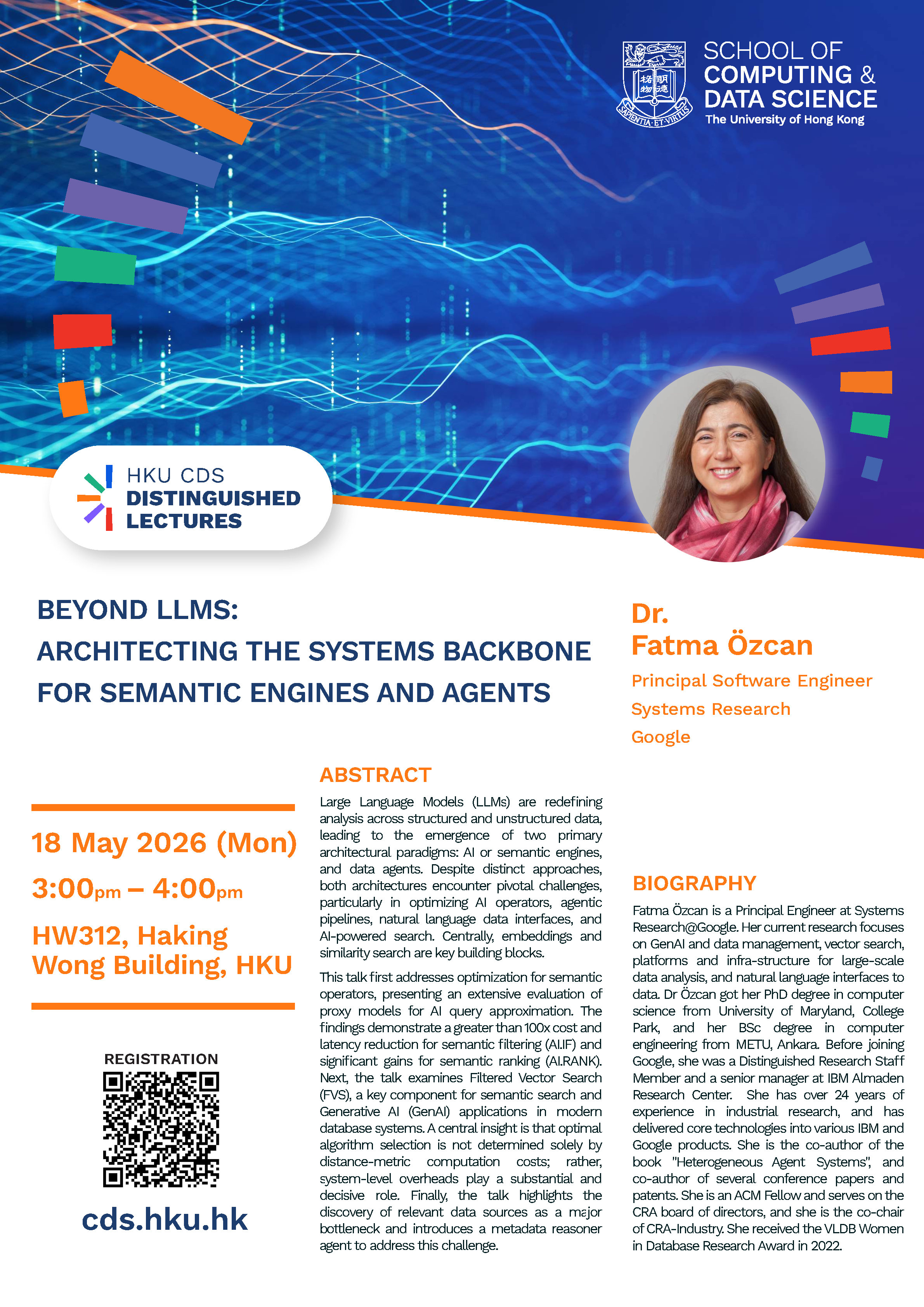
Title: Beyond LLMS: Architecting the systems backbone for semantic engines and agents
Time: 03:00pm
Venue: HW312, Haking Wong Building, HKU
Speaker(s): Dr. Fatma Özcan
Remark(s): Abstract
"Large Language Models (LLMs) are redefining analysis across structured and unstructured data, leading to the emergence of two primary architectural paradigms: AI or semantic engines, and data agents. Despite distinct approaches, both architectures encounter pivotal challenges, particularly in optimizing AI operators, agentic pipelines, natural language data interfaces, and AI-powered search. Centrally, embeddings and similarity search are key building blocks. This talk first addresses optimization for semantic operators, presenting an extensive evaluation of proxy models for AI query approximation. The findings demonstrate a greater than 100x cost and latency reduction for semantic filtering (AI.IF) and significant gains for semantic ranking (AI.RANK). Next, the talk examines Filtered Vector Search (FVS), a key component for semantic search and Generative AI (GenAI) applications in modern database systems. A central insight is that optimal algorithm selection is not determined solely by distance‑metric computation costs; rather, system‑level overheads play a substantial and decisive role. Finally, the talk highlights the discovery of relevant data sources as a major bottleneck and introduces a metadata reasoner agent to address this challenge."
About the speaker
"Fatma Özcan is a Principal Engineer at Systems Research@Google. Her current research focuses on GenAI and data management, vector search, platforms and infra-structure for large-scale data analysis, and natural language interfaces to
data. Dr Özcan got her PhD degree in computer science from University of Maryland, College Park, and her BSc degree in computer engineering from METU, Ankara. Before joining Google, she was a Distinguished Research Staff Member and a senior manager at IBM Almaden Research Center. She has over 24 years of experience in industrial research, and has delivered core technologies into various IBM and Google products. She is the co-author of the book ""Heterogeneous Agent Systems"", and co-author of several conference papers and patents. She is an ACM Fellow and serves on the CRA board of directors, and she is the co-chair of CRA-Industry. She received the VLDB Women in Database Research Award in 2022."
|
| May 21, 2026 |
-
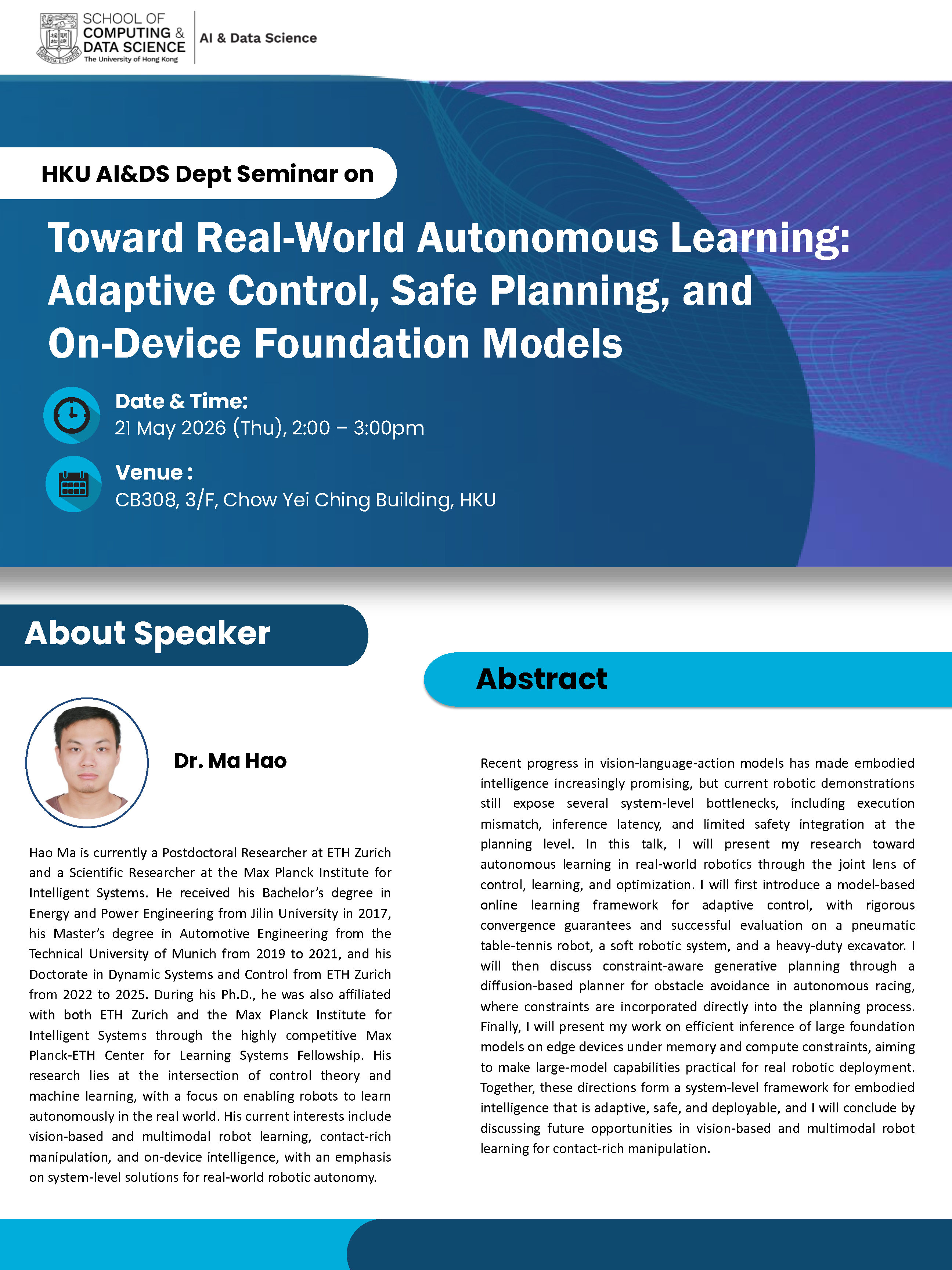
Title: Toward Real-World Autonomous Learning: Adaptive Control, Safe Planning, and On-Device Foundation Models
Time: 02:00pm
Venue: CB308, 3/F, Chow Yei Ching Building, HKU
Speaker(s): Dr. Ma Hao
Remark(s): Abstract
Recent progress in vision-language-action models has made embodied intelligence increasingly promising, but current robotic demonstrations still expose several system-level bottlenecks, including execution mismatch, inference latency, and limited safety integration at the planning level. In this talk, I will present my research toward autonomous learning in real-world robotics through the joint lens of control, learning, and optimization. I will first introduce a model-based online learning framework for adaptive control, with rigorous convergence guarantees and successful evaluation on a pneumatic table-tennis robot, a soft robotic system, and a heavy-duty excavator. I will then discuss constraint-aware generative planning through a diffusion-based planner for obstacle avoidance in autonomous racing, where constraints are incorporated directly into the planning process. Finally, I will present my work on efficient inference of large foundation models on edge devices under memory and compute constraints, aiming to make large-model capabilities practical for real robotic deployment. Together, these directions form a system-level framework for embodied intelligence that is adaptive, safe, and deployable, and I will conclude by discussing future opportunities in vision-based and multimodal robot learning for contact-rich manipulation.
About the speaker
Hao Ma is currently a Postdoctoral Researcher at ETH Zurich and a Scientific Researcher at the Max Planck Institute for Intelligent Systems. He received his Bachelor’s degree in Energy and Power Engineering from Jilin University in 2017, his Master’s degree in Automotive Engineering from the Technical University of Munich from 2019 to 2021, and his Doctorate in Dynamic Systems and Control from ETH Zurich from 2022 to 2025. During his Ph.D., he was also affiliated with both ETH Zurich and the Max Planck Institute for Intelligent Systems through the highly competitive Max Planck-ETH Center for Learning Systems Fellowship. His research lies at the intersection of control theory and machine learning, with a focus on enabling robots to learn autonomously in the real world. His current interests include vision-based and multimodal robot learning, contact-rich manipulation, and on-device intelligence, with an emphasis on system-level solutions for real-world robotic autonomy.
|
