Abstract
Collaborative intelligence, particularly Federated Learning, has emerged as a paradigm shift for decentralized knowledge discovery, promising to unlock data silos while safeguarding user privacy. However, real-world deployments face a critical "trilemma": the intrinsic tensions between rigorous privacy preservation, adversarial robustness, and system efficiency. In this talk, I will outline a roadmap to reconcile these challenges by exploring the intersection of efficiency, privacy and robustness -- focusing on methodologies that enable anomaly detection directly over encrypted models without compromising confidentiality, examining the security implications of communication-efficient FL, etc. Collectively, these insights pave the way for constructing a trustworthy, scalable, and secure collaborative AI ecosystem.
About the speaker
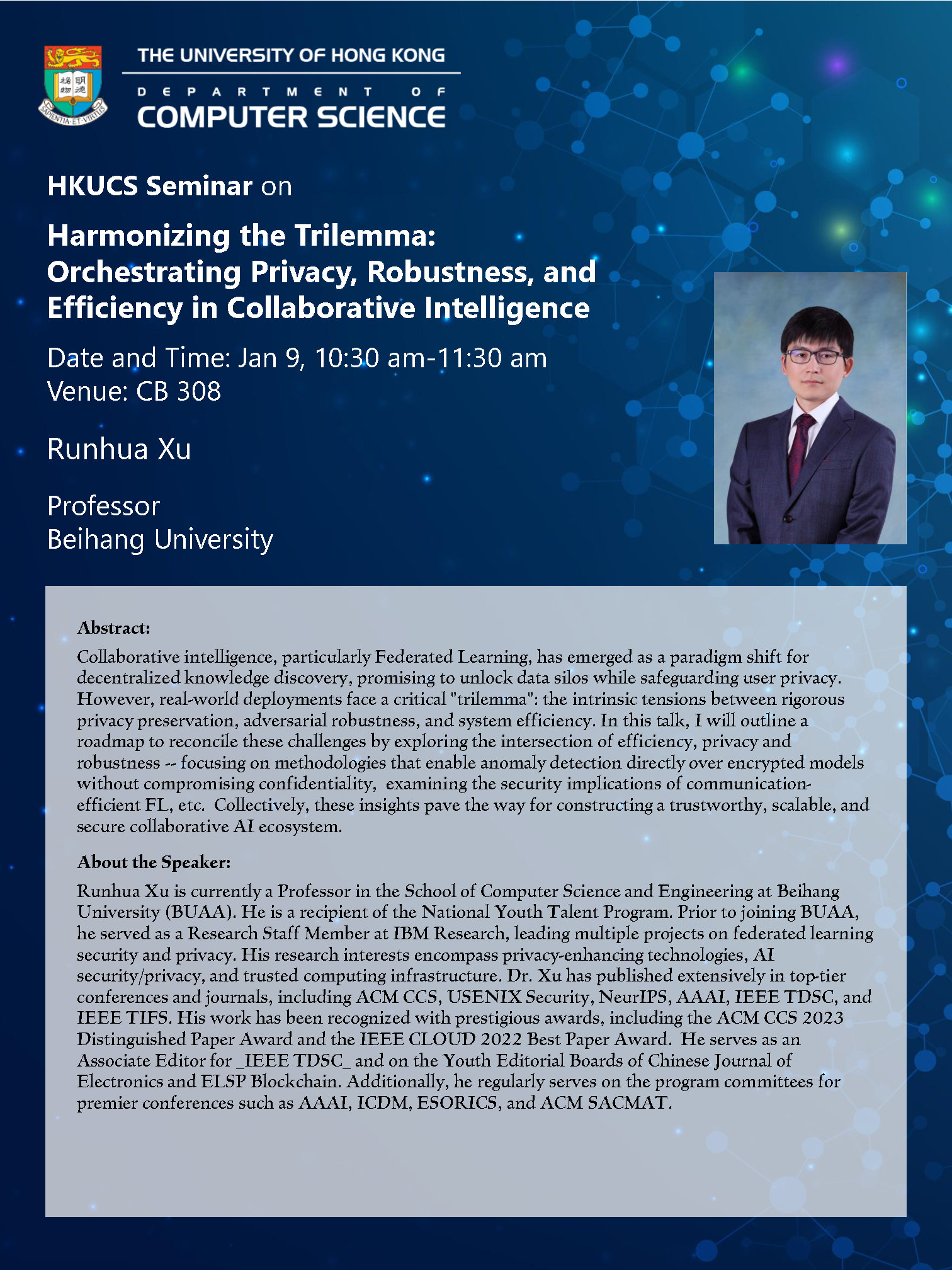
Runhua Xu is currently a Professor in the School of Computer Science and Engineering at Beihang University (BUAA). He is a recipient of the National Youth Talent Program. Prior to joining BUAA, he served as a Research Staff Member at IBM Research, leading multiple projects on federated learning security and privacy. His research interests encompass privacy-enhancing technologies, AI security/privacy, and trusted computing infrastructure. Dr. Xu has published extensively in top-tier conferences and journals, including ACM CCS, USENIX Security, NeurIPS, AAAI, IEEE TDSC, and IEEE TIFS. His work has been recognized with prestigious awards, including the ACM CCS 2023 Distinguished Paper Award and the IEEE CLOUD 2022 Best Paper Award. He serves as an Associate Editor for _IEEE TDSC_ and on the Youth Editorial Boards of Chinese Journal of Electronics and ELSP Blockchain. Additionally, he regularly serves on the program committees for premier conferences such as AAAI, ICDM, ESORICS, and ACM SACMAT.