|
Past Seminars and Events
|
| February 03, 2026 |
-
Title: AI in Security: Applications and Challenges
Time: 09:30am
Venue: CB 328
Speaker(s): Prof. Kai Chen
Remark(s): Abstract
The emergence of artificial intelligence (AI) has significantly impacted security research. On one hand, AI can enhance traditional defenses, making them more intelligent and efficient. On the other hand, intrinsic security issues of AI—such as adversarial examples, backdoors, large model "jailbreaking," hallucinations, and privacy concerns—have raised serious apprehensions regarding its deployment. This talk will address both aspects: it will focus on leveraging AI to advance software security research and also examine the security vulnerabilities of AI systems from a software adversarial perspective.
About the speaker
Dr. Kai Chen is a Professor at the Institute of Information Engineering, Chinese Academy of Sciences (IIE, CAS), and a Professor at the University of Chinese Academy of Sciences (UCAS). He serves as Director of the Center for Frontier Innovation and Integration of Science and Education, and Deputy Director of the State Key Laboratory of Cybersecurity Defense. He is a recipient of the National High-Level Talent Program and has been honored with numerous awards, including Global Youth Leader at the World Internet Conference, CAS Young Scientist Award, CCF-IEEE CS Young Computer Scientist Award, Beijing Science and Technology Award – Outstanding Youth Zhongguancun Prize, NASAC Young Software Innovator Award, Beijing Outstanding Youth Science Fund, and BAAI Young Scientist Fellowship. He has published over 150 papers in top-tier venues such as IEEE S&P, USENIX Security, ACM CCS, NDSS, and ICSE.

|
| February 02, 2026 |
-
Title: Scaling LLM Pre-training through Optimizing Data- and Management-Plane Communications
Time: 12:00pm
Venue: CB 308
Speaker(s): Dr. Zhuang Wang
Remark(s): Abstract
Large language models (LLMs) are profoundly reshaping the global economies and technology. Efficient systems for LLM pre-training are essential because they directly impact model quality, operational costs, and environmental sustainability. In this talk, Zhuang will present two system research projects designed to tackle fundamental communication challenges within LLM pre-training. ZEN (OSDI ‘25) addresses data plane challenges by optimizing synchronization strategies for sparse tensor communications. GEMINI (SOSP ’23) focuses on the management plane by redesigning the checkpoint storage system engineered to minimize failure recovery overheads.
About the speaker
Zhuang Wang is a Senior Applied Scientist at Amazon Annapurna Labs. He earned his Ph.D. in Computer Science from Rice University in 2023. His current research interests focus on efficient training and inference systems for large language models. He has published papers as the first author in prestigious venues including OSDI, SOSP, SIGCOMM, and EuroSys. Zhuang has served on the Program Committee for OSDI, ATC, and MLSys.

|
| January 30, 2026 |
-
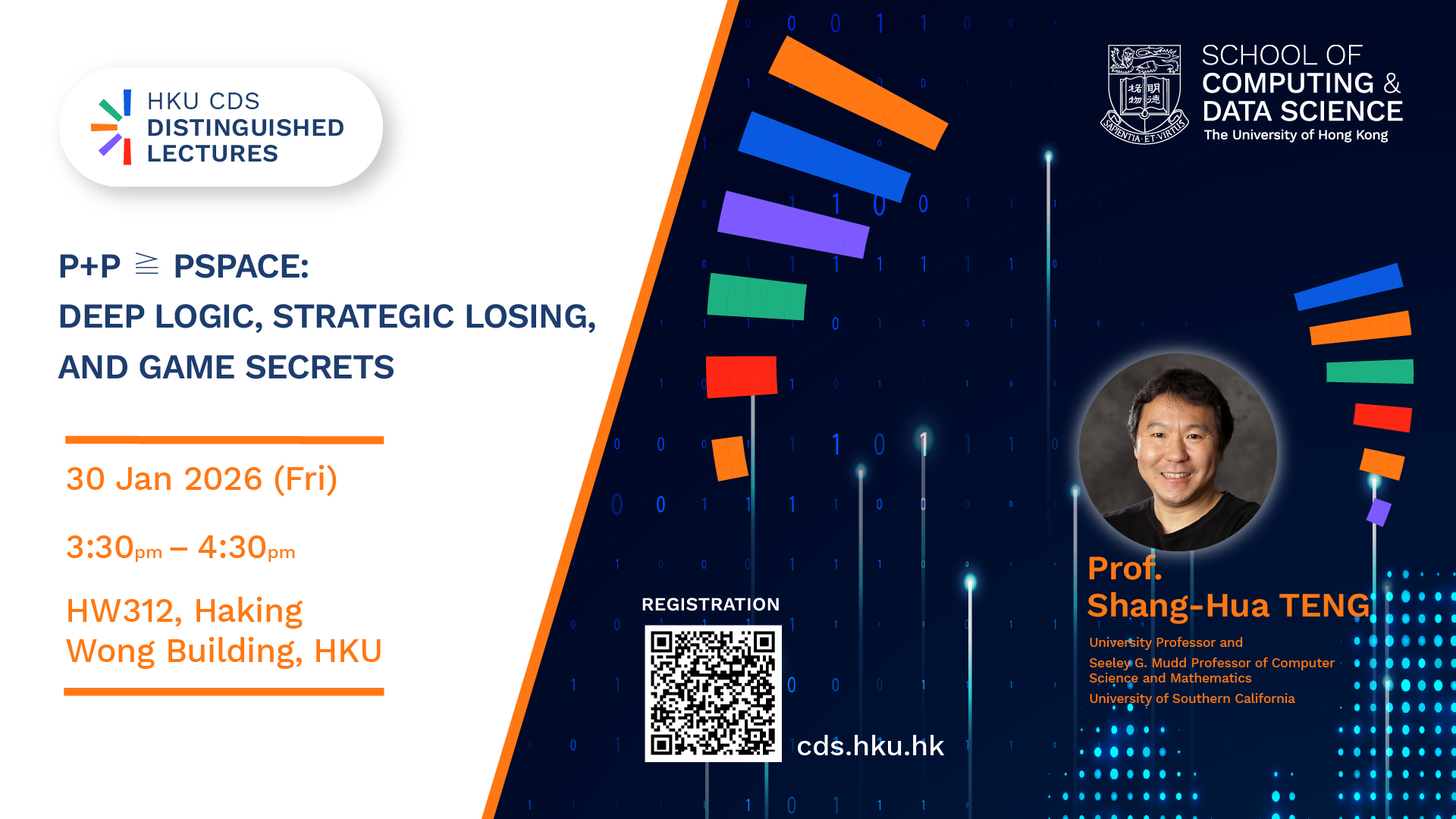
Title: P+P ≧ PSPACE: Deep Logic, Strategic Losing, and Game Secrets
Time: 03:30pm
Venue: HW312, Haking Wong Building
Speaker(s): Prof. Shang-Hua Teng
Remark(s): Abstract
A combinatorial game is defined by a ruleset specifying positions and feasible moves. In the normal-play setting, two players alternate moves, and the player forced to play at a terminal position—where no moves remain—loses. Optimal play often requires deep strategic reasoning and is typically PSPACE-hard. In Combinatorial Game Theory (CGT), the disjunctive sum of two games GGG and HHH, denoted G+HG + HG+H, allows the next player to move in exactly one component game.
In this talk, Prof. Teng shows that the sum of two polynomial-time solvable games can be PSPACE-hard. In other words, P + P ≥ PSPACE, where P and PSPACE represent families of polynomial-time and polynomial-space solvable games, and “+” denotes the disjunctive sum. This contrasts with classical Sprague-Grundy Theory (1930s), which states that the Grundy value of the sum of impartial games can be computed in polynomial time. Assuming PSPACE ≠ P, he proves there is no general polynomial-time method to combine two polynomial-time solvable impartial games to efficiently solve the sum. The results settle two long-standing complexity questions in CGT, open since 1981 and 1993. He will also draw a connection between the theorem and a famous Chinese idiom honouring strategist Zhuge Liang(諸葛亮) from The Romance of the Three Kingdoms(三國演義).
|
| January 23, 2026 |
-
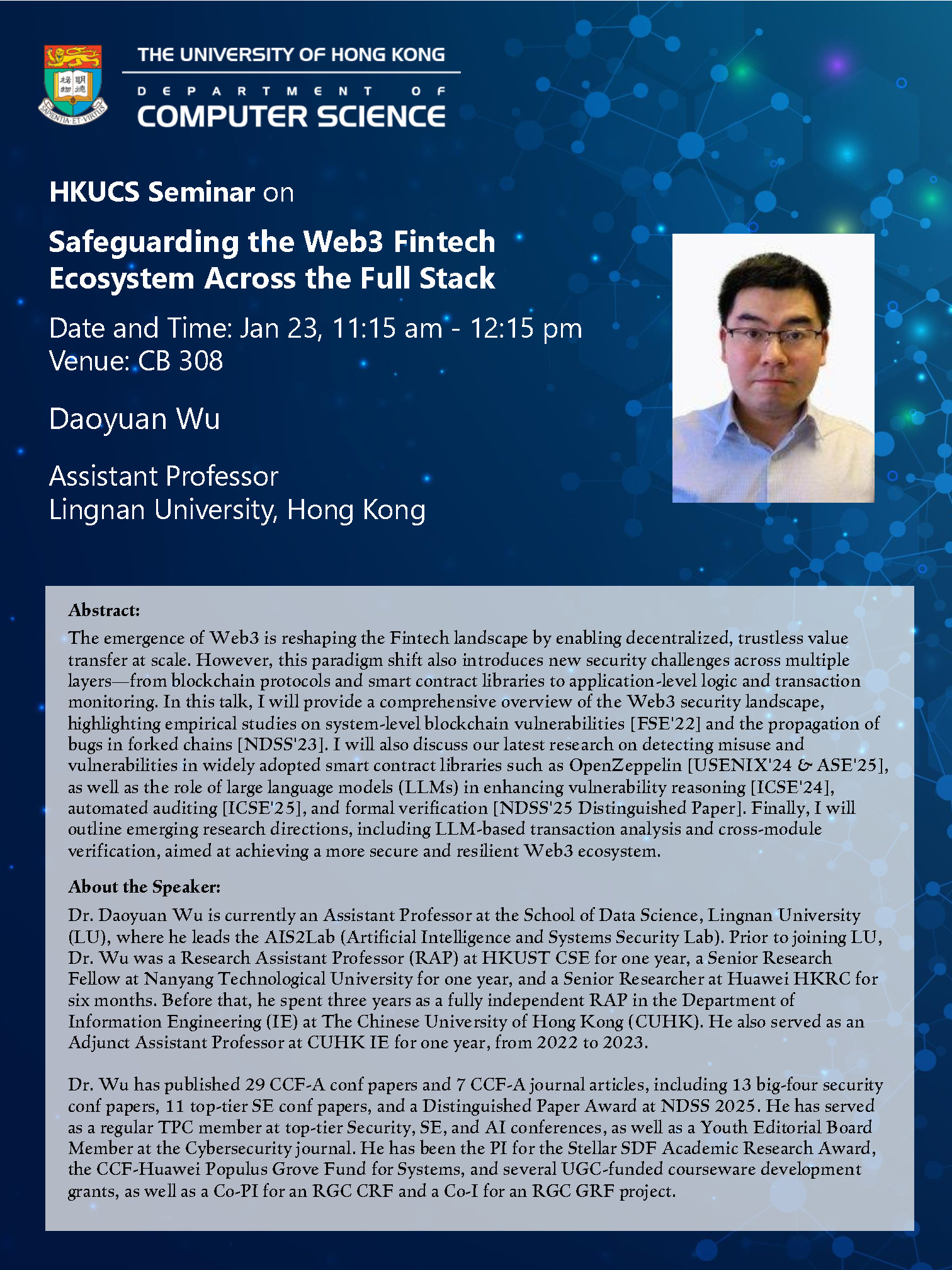
Title: Safeguarding the Web3 Fintech Ecosystem Across the Full Stack
Time: 11:15am
Venue: CB 308
Speaker(s): Prof. Daoyuan Wu
Remark(s): Abstract
The emergence of Web3 is reshaping the Fintech landscape by enabling decentralized, trustless value transfer at scale. However, this paradigm shift also introduces new security challenges across multiple layers—from blockchain protocols and smart contract libraries to application-level logic and transaction monitoring. In this talk, I will provide a comprehensive overview of the Web3 security landscape, highlighting empirical studies on system-level blockchain vulnerabilities [FSE'22] and the propagation of bugs in forked chains [NDSS'23]. I will also discuss our latest research on detecting misuse and vulnerabilities in widely adopted smart contract libraries such as OpenZeppelin [USENIX'24 & ASE'25], as well as the role of large language models (LLMs) in enhancing vulnerability reasoning [ICSE'24], automated auditing [ICSE'25], and formal verification [NDSS'25 Distinguished Paper]. Finally, I will outline emerging research directions, including LLM-based transaction analysis and cross-module verification, aimed at achieving a more secure and resilient Web3 ecosystem.
|
| January 19, 2026 |
-
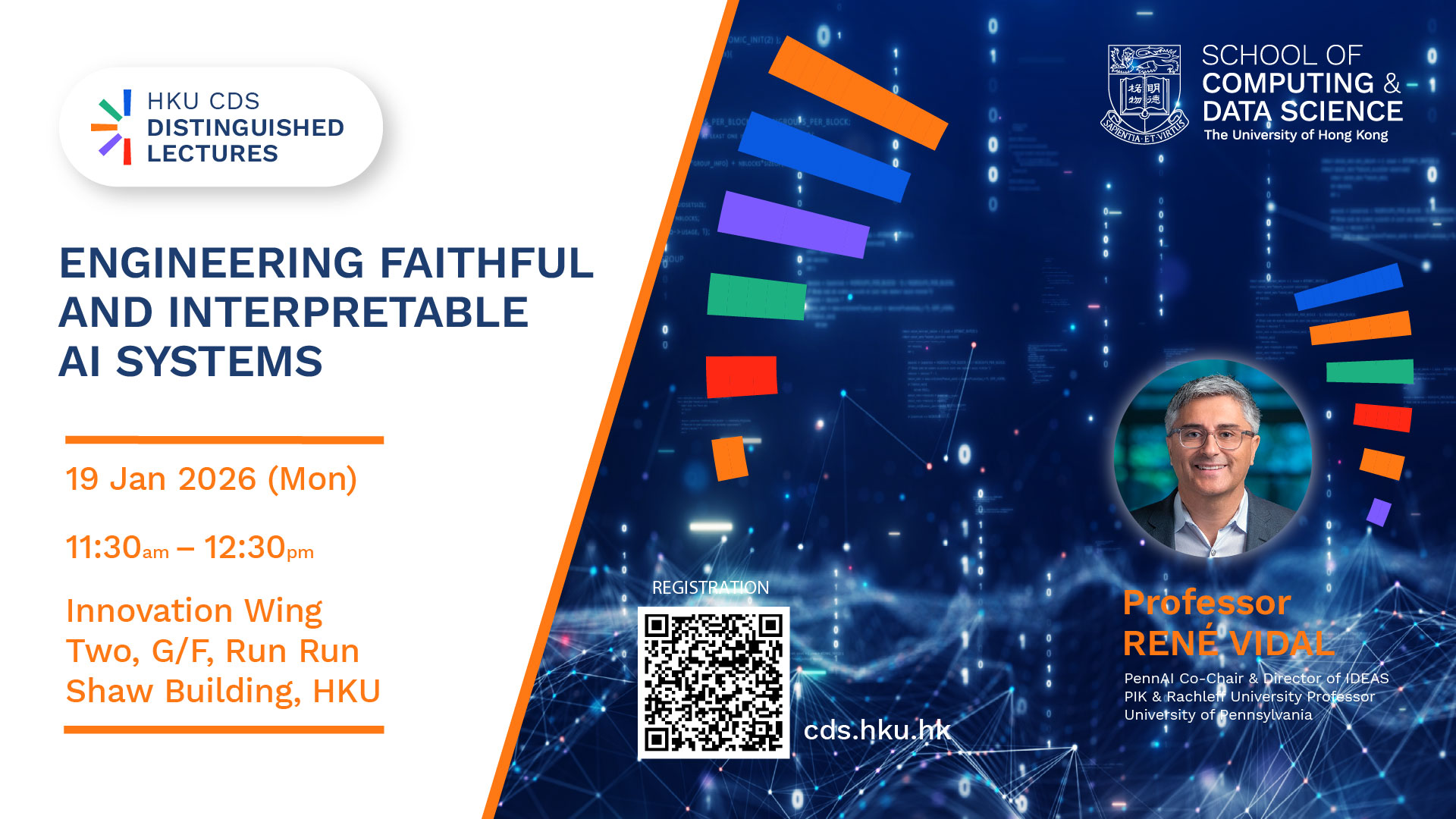
Title: Engineering Faithful and Interpretable AI Systems
Time: 11:30am
Venue: Innovation Wing Two, G/F, Run Run Shaw Building
Speaker(s): Prof. René Vidal
Remark(s): Abstract
Large Language Models (LLMs) and Vision Language Models (VLMs) have achieved remarkable performance across a wide range of tasks. However, their growing deployment has exposed fundamental limitations in faithfulness, safety, and transparency. In this talk, Prof. Vidal will present a unified perspective on addressing these challenges through principled model interventions and interpretable decision-making frameworks. He first introduces Parsimonious Concept Engineering (PaCE), an approach that improves faithfulness and alignment by selectively removing undesirable internal activations, mitigating hallucinations and biased language while preserving linguistic competence. Prof. Vidal then present Information Pursuit (IP), an interpretable-by-design prediction framework that replaces opaque reasoning with a sequence of informative, user-interpretable queries, yielding concise explanations alongside accurate predictions. Results across text, vision, and medical tasks illustrate how these ideas advance transparency without sacrificing performance. Together, these contributions point toward a broader direction for building AI systems that are powerful, faithful, and aligned with human values.
About the speaker
René Vidal is the Penn Integrates Knowledge and Rachleff University Professor of Electrical and Systems Engineering & Radiology, the Director of the Center for Innovation in Data Engineering and Science (IDEAS), and Co-Chair of Penn AI at the University of Pennsylvania. He is also an Amazon Scholar, an Affiliated Chief Scientist at NORCE, and a former Associate Editor in Chief of TPAMI. His current research focuses on the foundations of deep learning and trustworthy AI and its applications in computer vision and biomedical data science. His lab has made seminal contributions to motion segmentation, action recognition, subspace clustering, matrix factorization, deep learning theory, interpretable AI, and biomedical image analysis. He is an ACM Fellow, AIMBE Fellow, IEEE Fellow, IAPR Fellow and Sloan Fellow, and has received numerous awards for his work, including the IEEE Edward J. McCluskey Technical Achievement Award, D’Alembert Faculty Award, J.K. Aggarwal Prize, ONR Young Investigator Award, NSF CAREER Award as well as best paper awards in machine learning, computer vision, signal processing, controls, and medical robotics.
|
| January 09, 2026 |
-
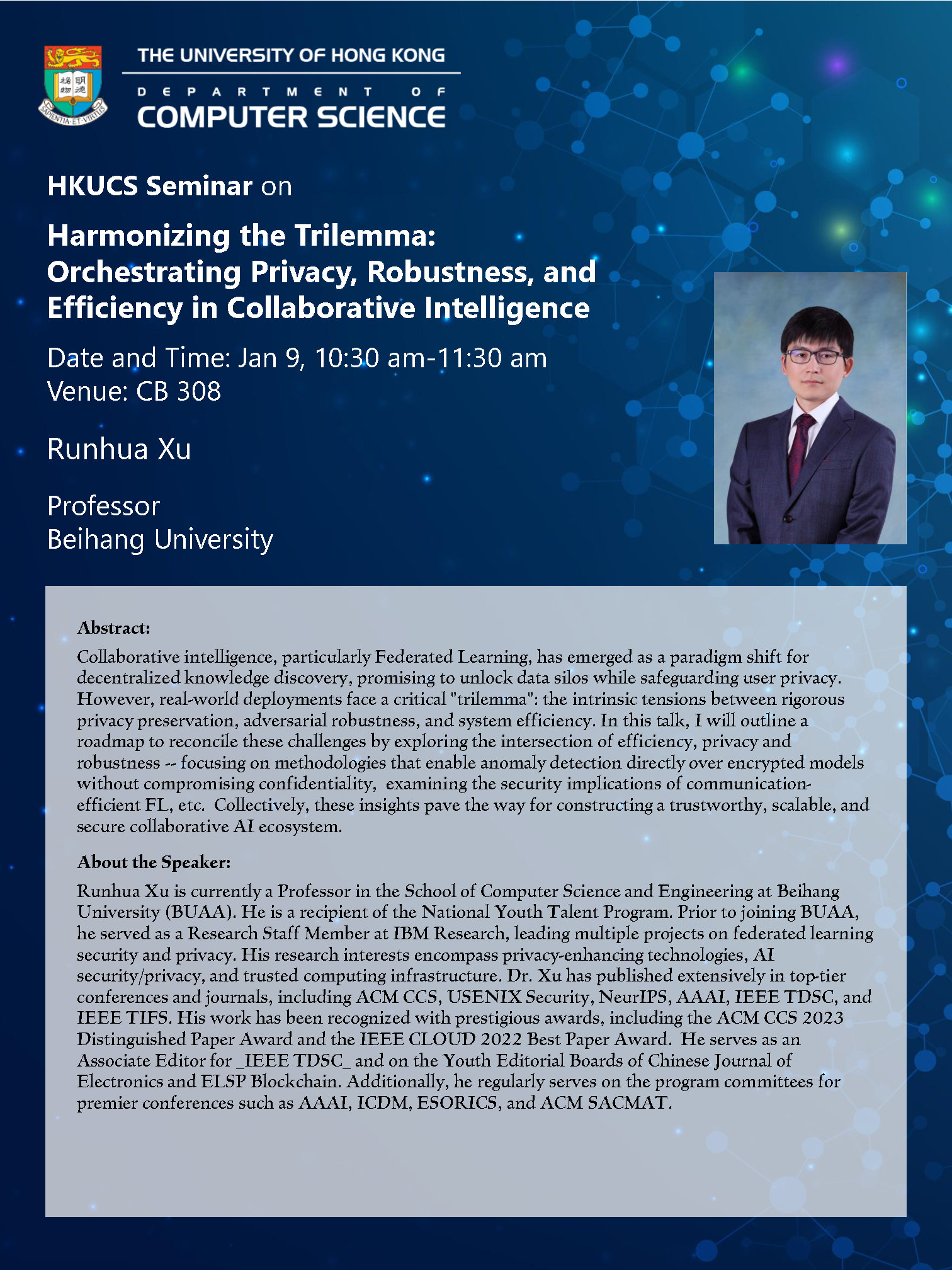
Title: Harmonizing the Trilemma: Orchestrating Privacy, Robustness, and Efficiency in Collaborative Intelligence
Time: 10:30am
Venue: CB 308
Speaker(s): Prof. Runhua Xu
Remark(s): Abstract
Collaborative intelligence, particularly Federated Learning, has emerged as a paradigm shift for decentralized knowledge discovery, promising to unlock data silos while safeguarding user privacy. However, real-world deployments face a critical "trilemma": the intrinsic tensions between rigorous privacy preservation, adversarial robustness, and system efficiency. In this talk, I will outline a roadmap to reconcile these challenges by exploring the intersection of efficiency, privacy and robustness -- focusing on methodologies that enable anomaly detection directly over encrypted models without compromising confidentiality, examining the security implications of communication-efficient FL, etc. Collectively, these insights pave the way for constructing a trustworthy, scalable, and secure collaborative AI ecosystem.
About the speaker
Runhua Xu is currently a Professor in the School of Computer Science and Engineering at Beihang University (BUAA). He is a recipient of the National Youth Talent Program. Prior to joining BUAA, he served as a Research Staff Member at IBM Research, leading multiple projects on federated learning security and privacy. His research interests encompass privacy-enhancing technologies, AI security/privacy, and trusted computing infrastructure. Dr. Xu has published extensively in top-tier conferences and journals, including ACM CCS, USENIX Security, NeurIPS, AAAI, IEEE TDSC, and IEEE TIFS. His work has been recognized with prestigious awards, including the ACM CCS 2023 Distinguished Paper Award and the IEEE CLOUD 2022 Best Paper Award. He serves as an Associate Editor for _IEEE TDSC_ and on the Youth Editorial Boards of Chinese Journal of Electronics and ELSP Blockchain. Additionally, he regularly serves on the program committees for premier conferences such as AAAI, ICDM, ESORICS, and ACM SACMAT.
|
| January 08, 2026 |
-
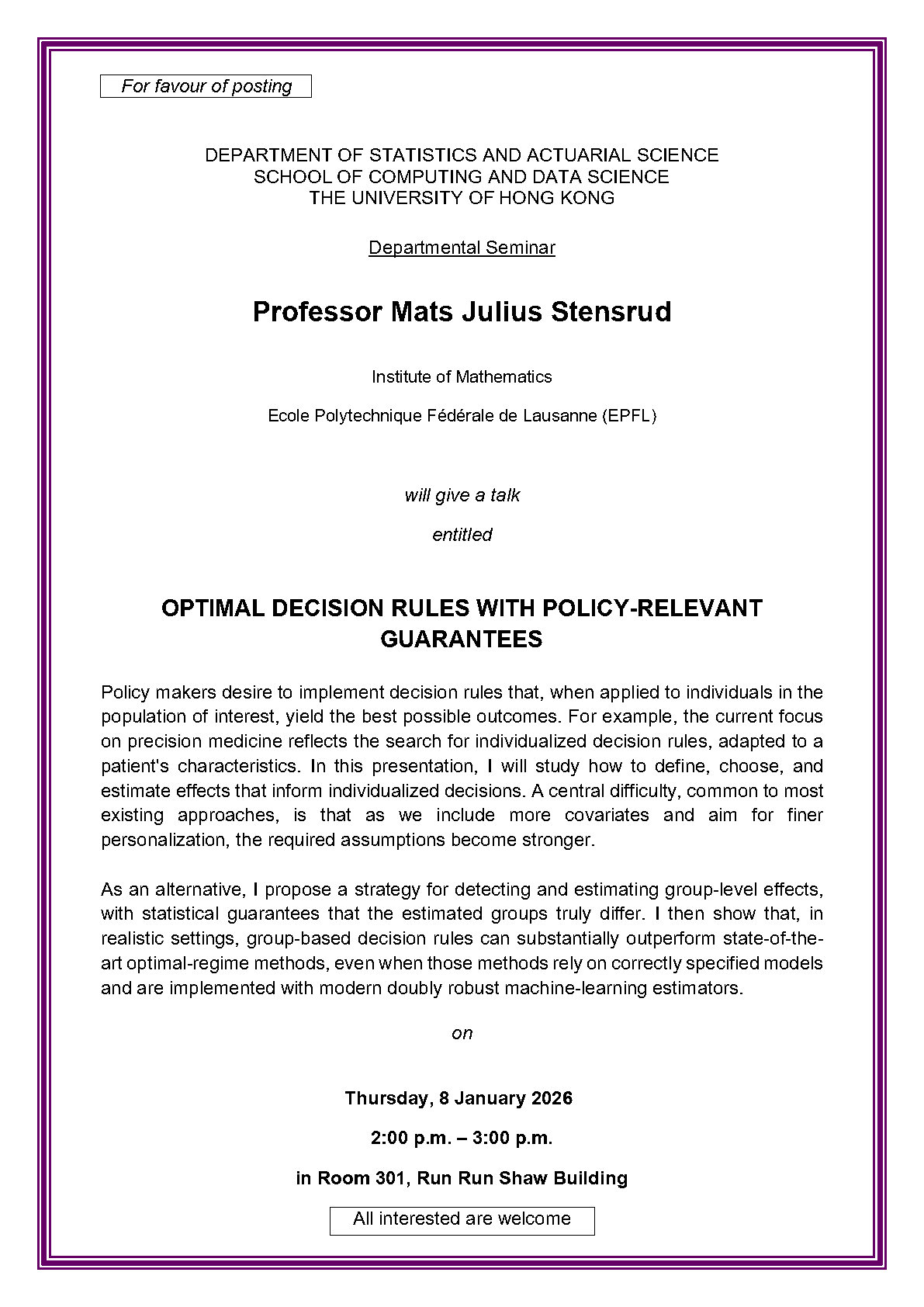
Title: Optimal Decision Rules With Policy-Relevant Guarantees
Time: 02:00pm
Venue: Room 301, Run Run Shaw Building
Speaker(s): Prof. Mats Julius Stensrud
Remark(s): Abstract
Policy makers desire to implement decision rules that, when applied to individuals in the population of interest, yield the best possible outcomes. For example, the current focus on precision medicine reflects the search for individualized decision rules, adapted to a patient's characteristics. In this presentation, I will study how to define, choose, and estimate effects that inform individualized decisions. A central difficulty, common to most existing approaches, is that as we include more covariates and aim for finer personalization, the required assumptions become stronger.
As an alternative, I propose a strategy for detecting and estimating group-level effects,with statistical guarantees that the estimated groups truly differ. I then show that, in realistic settings, group-based decision rules can substantially outperform state-of-the-art optimal-regime methods, even when those methods rely on correctly specified models and are implemented with modern doubly robust machine-learning estimators.
-
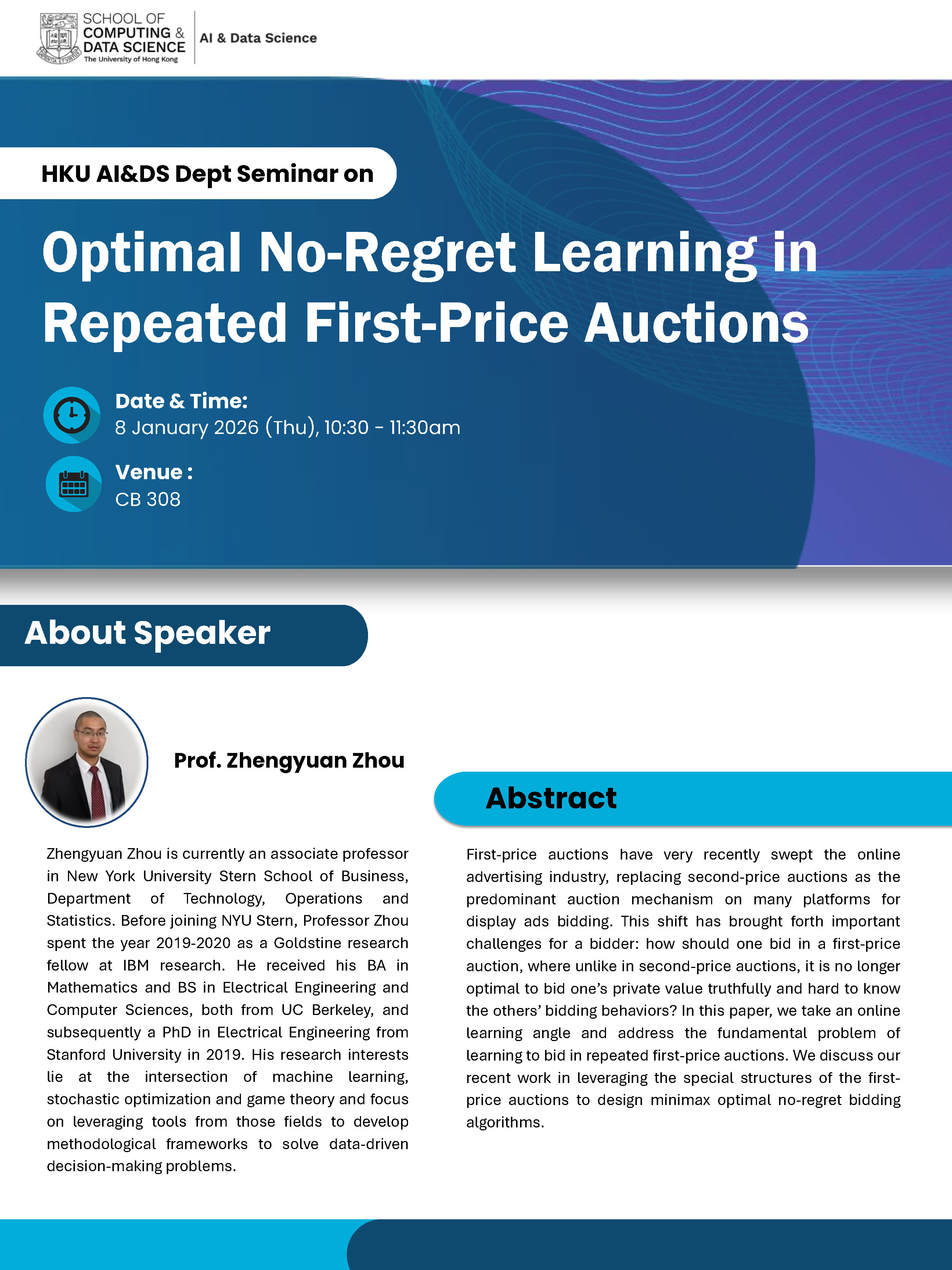
Title: Optimal No-Regret Learning in Repeated First-Price Auctions
Time: 10:30am
Venue: CB 308
Speaker(s): Prof. Zhengyuan Zhou, New York University Stern School of Business
Remark(s): Abstract
First-price auctions have very recently swept the online advertising industry, replacing second-price auctions as the predominant auction mechanism on many platforms for display ads bidding. This shift has brought forth important challenges for a bidder: how should one bid in a first-price auction, where unlike in second-price auctions, it is no longer optimal to bid one’s private value truthfully and hard to know the others’ bidding behaviors? In this paper, we take an online learning angle and address the fundamental problem of learning to bid in repeated first-price auctions. We discuss our recent work in leveraging the special structures of the first-price auctions to design minimax optimal no-regret bidding algorithms.
About the speaker
Zhengyuan Zhou is currently an associate professor in New York University Stern School of Business, Department of Technology, Operations and Statistics. Before joining NYU Stern, Professor Zhou spent the year 2019-2020 as a Goldstine research fellow at IBM research. He received his BA in Mathematics and BS in Electrical Engineering and Computer Sciences, both from UC Berkeley, and subsequently a PhD in Electrical Engineering from Stanford University in 2019. His research interests lie at the intersection of machine learning, stochastic optimization and game theory and focus on leveraging tools from those fields to develop methodological frameworks to solve data-driven decision-making problems.
|
| January 07, 2026 |
-
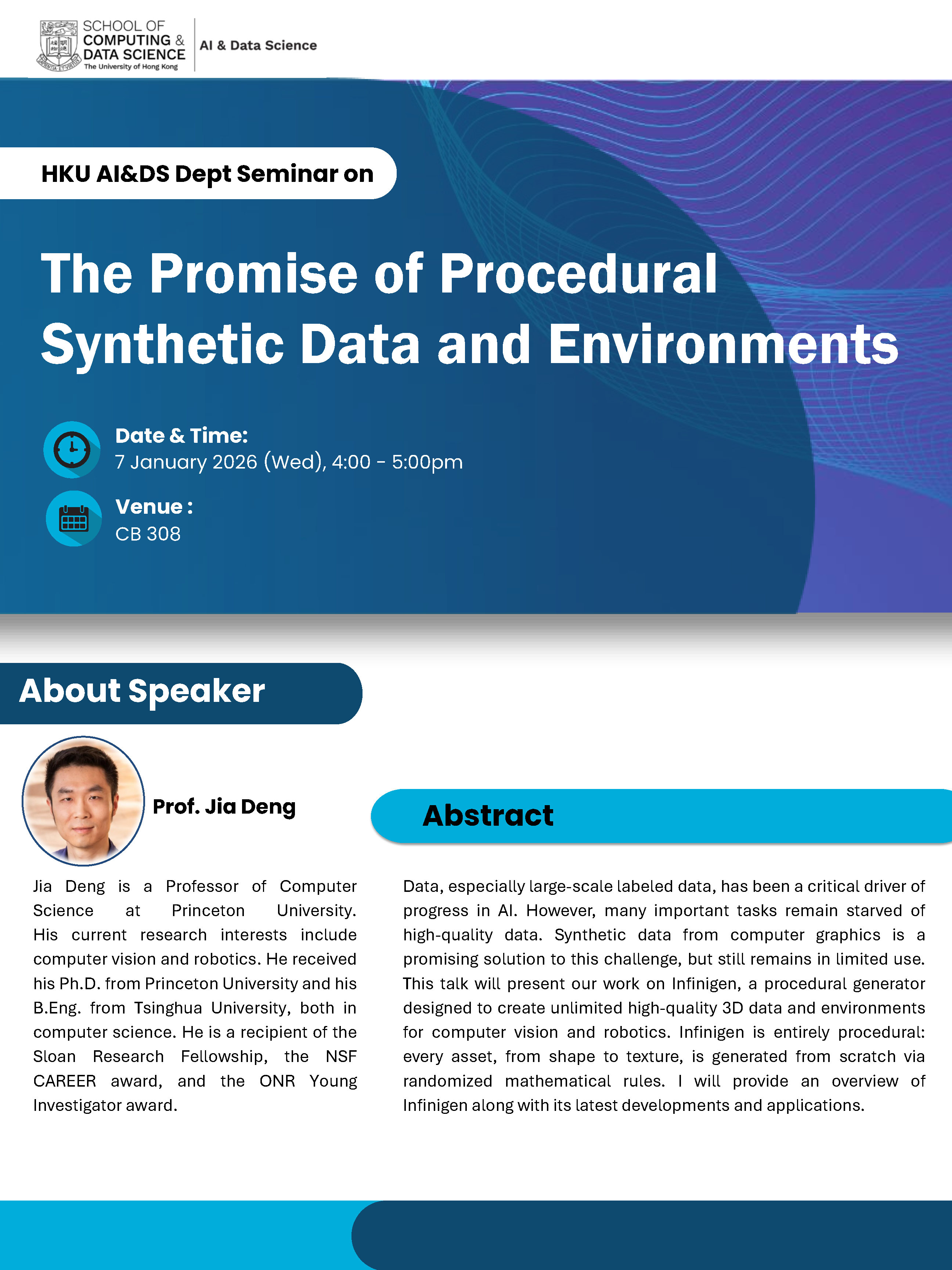
Title: The Promise of Procedural Synthetic Data and Environments
Time: 04:00pm
Venue: CB 308
Speaker(s):
Remark(s): Abstract
Data, especially large-scale labeled data, has been a critical driver of progress in AI. However, many important tasks remain starved of high-quality data. Synthetic data from computer graphics is a promising solution to this challenge, but still remains in limited use. This talk will present our work on Infinigen, a procedural generator designed to create unlimited high-quality 3D data and environments for computer vision and robotics. Infinigen is entirely procedural: every asset, from shape to texture, is generated from scratch via randomized mathematical rules. I will provide an overview of Infinigen along with its latest developments and applications.
About the speaker
Jia Deng is a Professor of Computer Science at Princeton University. His current research interests include computer vision and robotics. He received his Ph.D. from Princeton University and his B.Eng. from Tsinghua University, both in computer science. He is a recipient of the Sloan Research Fellowship, the NSF CAREER award, and the ONR Young Investigator award.
|
| December 19, 2025 |
-
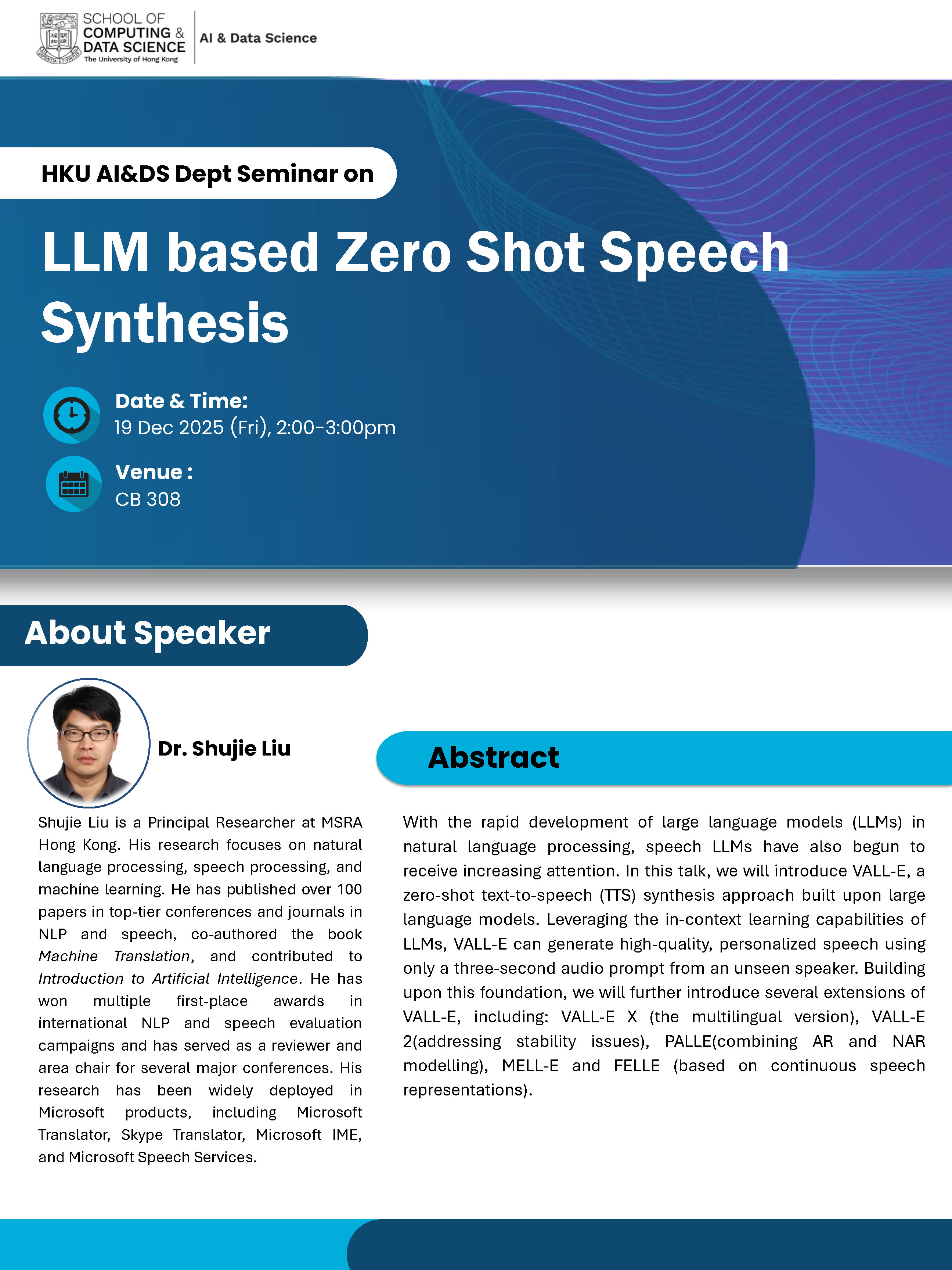
Title: LLM based Zero Shot Speech Synthesis
Time: 02:00pm
Venue: CB 308
Speaker(s): Dr. Shujie Liu
Remark(s): Abstract
With the rapid development of large language models (LLMs) in natural language processing, speech LLMs have also begun to receive increasing attention. In this talk, we will introduce VALL‑E, a zero‑shot text‑to‑speech (TTS) synthesis approach built upon large language models. Leveraging the in‑context learning capabilities of LLMs, VALL‑E can generate high‑quality, personalized speech using only a three‑second audio prompt from an unseen speaker. Building upon this foundation, we will further introduce several extensions of VALL‑E, including: VALL‑E X (the multilingual version), VALL‑E 2(addressing stability issues), PALLE(combining AR and NAR modelling), MELL‑E and FELLE (based on continuous speech representations).
About the speaker
Shujie Liu is a Principal Researcher at MSRA Hong Kong. His research focuses on natural language processing, speech processing, and machine learning. He has published over 100 papers in top-tier conferences and journals in NLP and speech, co‑authored the book Machine Translation, and contributed to Introduction to Artificial Intelligence. He has won multiple first‑place awards in international NLP and speech evaluation campaigns and has served as a reviewer and area chair for several major conferences. His research has been widely deployed in Microsoft products, including Microsoft Translator, Skype Translator, Microsoft IME, and Microsoft Speech Services.
|
